

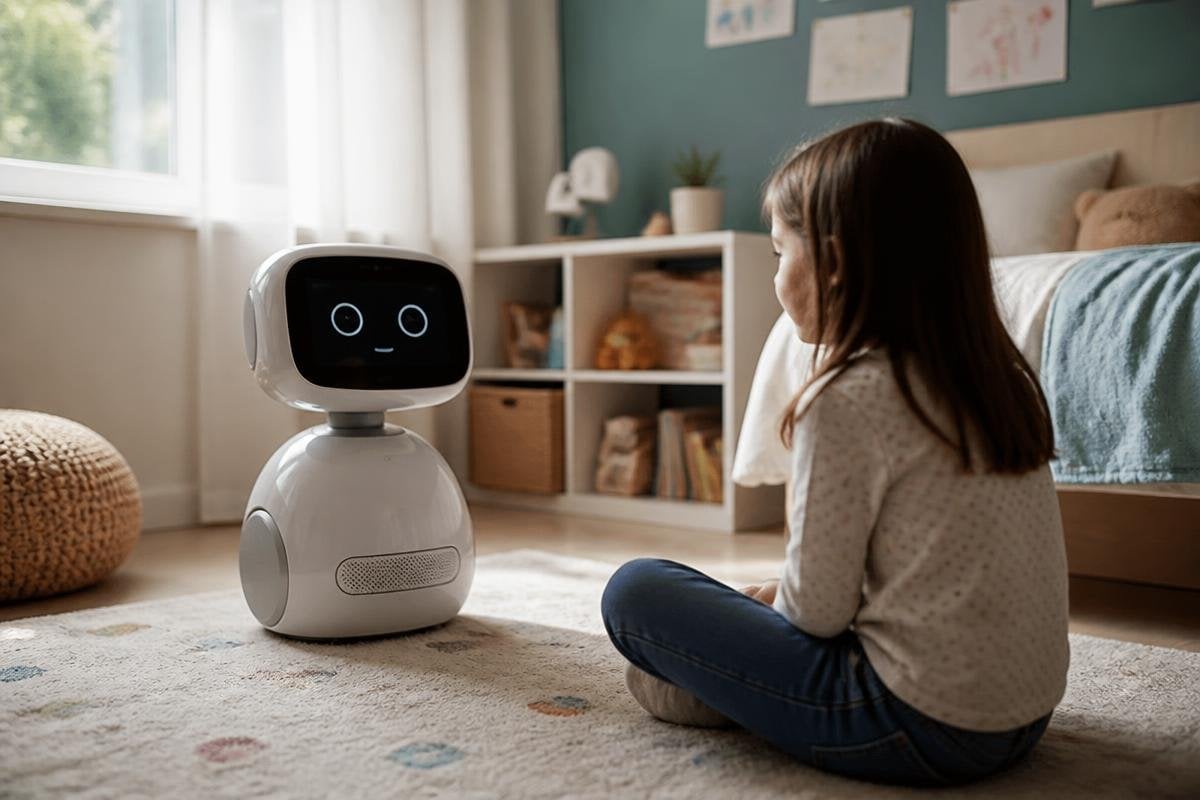
A social robot is built to talk, respond, and take part in a child’s daily setting. That role creates a duty to give children stronger protections than an ordinary gadget would receive. The case for special rights rests on privacy, safety, informed choice, and a child’s ability to leave the interaction.
Quick read
- Children may not understand what a robot records or sends elsewhere
- A robot must not pressure a child to keep talking
- Parents need clear controls, while children need a voice in the rules
What makes social robots different
A toy usually waits for a child to press a button. A social robot can speak first, notice a response, and change its next action. That exchange can feel personal even when the system has no feelings or private intentions.
This matters because children are still learning how trust works. A friendly voice, a familiar name, or a repeated reward can make a robot feel like a companion. The child may then share family details, worries, school problems, or private routines without knowing who can access that information.
Special rights would not mean giving the robot legal status. They would mean giving the child extra control over a system that can shape attention and behavior. The rules would follow the child, not the robot’s marketing label.
The rights children need
The first right is a clear explanation. A child should be told, in words suited to their age, when the robot records sound, uses a camera, stores a profile, or sends data to another service. A long adult policy document doesn’t meet that need.
The second is a real choice. The robot should work in a limited mode when a child declines recording or personal features. They should also be able to end a session without losing access to a lesson, game, or household service.
The third is a right to human help. A robot can answer a question, but it should not become the only place where a child can report fear, bullying, injury, or distress. A clear handoff to a parent, teacher, or other responsible adult needs to exist before the product reaches a home or school.
The fourth is freedom from pressure. Rewards, repeated prompts, and emotional language can keep a child engaged longer than they planned. Product rules should block tactics that make silence feel like rejection or make the child feel responsible for the robot’s welfare.
Parents need control, children need a voice
Adults usually manage the account, network, and device settings. That control matters, but it cannot replace the child’s voice. A parent may approve a robot for homework while the child feels watched during private conversations.
A better setup gives adults firm controls over recording, storage, contacts, and operating hours. It also gives children a visible way to ask what the robot knows, delete a conversation, pause the camera, or report behavior that feels wrong.
Age bands may help. A system made for a six-year-old should use different prompts and data settings from one used by a sixteen-year-old. The exact limits need testing with families, schools, child-safety groups, and engineers rather than being set by product teams alone.
A social robot can shape a child’s daily routine through prompts, cameras, and stored data. Reports on social robot safety can tie the policy debate to machines children may meet at home or school, where consent and refusal are harder to judge.
What remains unproven
The case for added safeguards is strong, but several design questions still need evidence.
It is not enough to say that a robot has parental controls. Someone must check how those controls work during a real conversation, how quickly a child can use them, and what happens after a mistake.
The same test applies to data deletion. A button labelled “delete” may remove a visible chat while leaving other records in a service account. Makers need to state what disappears, when it disappears, and who can restore it.
I would give a child more control over the interaction than most connected toys receive, even if that reduces some product features. A robot that loses access to personal data is easier to live with than one that earns trust by quietly collecting more of it.
A buying and design checklist
Before a social robot reaches a child, check these points:
- Name the data: list every sensor, recording type, and stored detail
- Test the exit: confirm that the child can stop a session without punishment
- Set human help: name the adult or service that handles serious concerns
- Limit pressure: remove prompts that shame, frighten, or guilt the child
- Check deletion: verify what gets erased and how long backups remain
- Review by age: match language, features, and settings to the child’s age
These checks turn special rights into product requirements. They also give parents and schools something they can inspect before trust is placed in the machine.
A child-facing social robot should ship with clear data controls, a working human handoff, and a child-sized way to say no. Until makers can show those three things in practice, the robot belongs in a supervised setting rather than a child’s private space.
